human-safe-ai-score-2026-findings

Leaders Said Go. Nobody Said How.

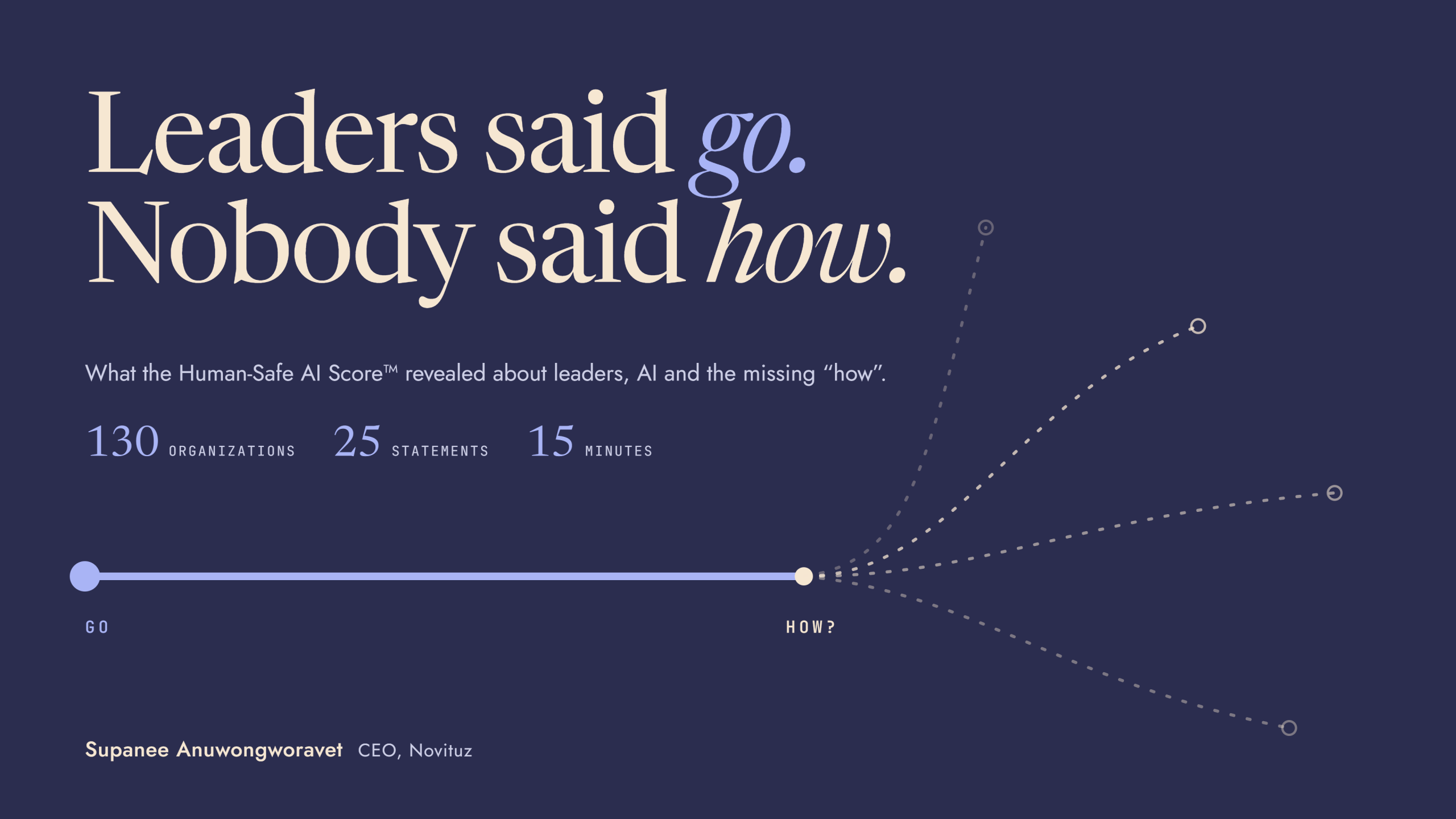
Leaders said go. Nobody said how.

Thai leaders are telling their people to use AI, and their people are listening. What 130 organizations reveal about the missing “how”, and why the fix fits on one page.

70%of organizations where employees already use AI do not agree their AI policy is enforced with a clear owner
61%of organizations whose top leaders treat AI as a core priority say the same
54%of organizations already using AI do not agree they provide approved AI tools
15 ptsgap between leadership readiness (69) and governance (54), out of 100

In short

  • The “go” is loud. Leadership is the strongest readiness dimension, and employees are already using AI.
  • The “how” is missing, even in the same organizations where people use AI every day.
  • When the direction is clear but the rules aren’t, people write their own. The fix starts with leaders, and fits on one page.

Imagine one employee in an office somewhere in Bangkok. Let’s call her Ploy.

On Monday, her manager told the team they needed to use AI more. On Tuesday, Ploy did. With forty customer emails to answer before lunch, she opened a free AI chatbot on her phone and pasted in the first one. Thirty seconds later she had a better reply than she would have written in ten minutes. By eleven, her inbox was empty.

Her manager had said go. Nobody had said how: which tool to use, what never to paste into it, who to ask if something went wrong.

Ploy isn’t doing anything wrong. She is doing exactly what she was asked.

Why I wanted to know

As a speaker and trainer, I spend a lot of time in rooms with leadership teams learning to work with AI. Again and again, the answers and the level of awareness in those rooms surprised me. The enthusiasm was real. The clarity about rules, ownership and safe use often wasn’t.

I wanted to know whether those moments were the exception or the rule. So we built a way to check: the Human-Safe AI Score™, twenty-five statements and fifteen minutes on whether people can use AI with confidence while keeping their judgment, their trust and ownership of their work.

This year, leaders from 130 organizations took it, from manufacturing and banking to hospitality, energy and healthcare. It is not a national survey. But the answer to my question was clear.

Readiness by dimension

Average score out of 100, 130 organizations

Leadership
69.3
Culture
64.7
Workforce
59.4
Talent
56.3
Governance
54.3

Source: Novituz Human-Safe AI Score™ 2026, preliminary findings

The “go” is loud

Thai leaders are not hesitating on AI. Leadership was the strongest of the five dimensions we measure, at 69 out of 100. And people are responding: the single highest-scoring statement of all twenty-five was “Employees have started using AI in their real, everyday work” (3.96 out of 5).

Microsoft sees the same from the employee side. In its 2026 Work Trend Index for Thailand, 51% of Thai workers say their leaders give clear direction on AI, nearly double the global average.

The “how” is missing, in the same organizations

The lowest-scoring statement of all was “Our AI policy is enforced, monitored, and has a clear owner” (2.75 out of 5). All six governance statements landed among the seven lowest, and governance came last overall, at 54 out of 100.

Averages can hide things, so we looked organization by organization. Among the organizations where employees already use AI at work, 70% did not agree that their AI policy is enforced with a clear owner, and 54% did not agree that they provide approved AI tools. Even where top leaders treat AI as a core priority, 61% said the same about their policy.

The go and the missing how live in the same building.

Human-Safe AI Score™ 2026

Leaders said go. Nobody said how.

70%
of organizations already using AI: no enforced AI policy with an owner
61%
even where top leaders make AI a priority
54/100
governance, the weakest readiness dimension

Human-Safe AI Score™ 2026 · 130 Thai organizations · novituz.com · © 2026 Novituz. All rights reserved.

When nobody says how, people write their own rules

What does a motivated employee do when told to use AI, with no approved tool and no rules? Exactly what Ploy did. She finds her own.

That is how shadow AI grows: not from rule-breakers, but from willing people filling a gap their leaders left open. Each time someone pastes a customer’s email into a tool nobody approved, they make a data decision on the company’s behalf without knowing it.

What employees tell Microsoft

Work Trend Index 2026 · Thai workers

  • 51% get clear AI direction from leaders
  • 89% use AI output as a starting point
  • Only 2 in 10 teams turn AI wins into standard workflows

What organizations tell us

Human-Safe AI Score™ 2026 · 130 organizations

  • Leadership is the strongest dimension (69/100)
  • Governance is the weakest (54/100)
  • 70% already using AI lack an enforced policy with an owner

Different people, same moment: the energy is there, and the structure has not arrived. Deloitte finds 81% of Thai organizations still experimenting, and NECTEC finds 86.4% cannot measure what their AI has achieved. What our data adds is where the gap sits: inside the organization, which means leaders can close it.

“Isn’t fast adoption a good thing?”

Yes. The answer is not to slow Ploy down; the curiosity and trust in these numbers are an asset. Nor is it a forty-page policy she will never read. The answer is to finish the sentence leaders have already started. You said go. Now say how, on one page.

© 2026 Novituz. All rights reserved.

The One-Page How

Six questions every team should be able to answer. Screenshot it, share it, fill it in.

1

Who owns AI here?

One named person accountable for how AI is used, and how to reach them.

2

Which tools are approved?

The tools people should use, and where to get access and support.

3

What never goes in?

Customer data, personal data, confidential numbers: name them plainly.

4

What must a human check?

Which outputs need a person to review before they reach a customer or a decision. Who should decide: AI or humans?

5

What does success look like?

The value you expect: quality, time returned, new ideas. Not just headcount.

6

When do we review this?

A date to update the page as tools and lessons change.

Next Monday

Imagine Ploy’s manager standing up again: “Use AI more. Here is our one page: the tool we use, what never goes into it, and who to ask. Show me what you build.”

Ploy will still clear her inbox by eleven. The difference is that now her organization is moving as fast as she is.

That is what human-centric AI looks like. Not slowing people down. Leading them, all the way to the how.

Supanee Supanee Anuwongworavet · Founder and CEO, Novituz

You’ve said go. Do you know your how?

The Human-Safe AI Score™ shows in fifteen minutes, for free, where your organization stands across leadership, culture, workforce, talent and governance. If your gap looks like the one in this article, we help leadership teams turn the One-Page How into how they actually work.

About this data

These are preliminary findings from 130 organizations that completed the Human-Safe AI Score™ in 2026. Each organization was represented by one respondent. Organization-level percentages (70%, 61%, 54%) are based on the 92 organizations that answered every statement; “did not agree” includes neutral answers. Responses are self-reported on a five-point scale and converted to 0–100 scores per dimension. Because participants took part voluntarily rather than through a random sample, results describe this group and should not be read as representative of all Thai organizations. No individual or company is identified.