
In short
“I’m not a tech person.” For the first time, that sentence no longer has to be true.
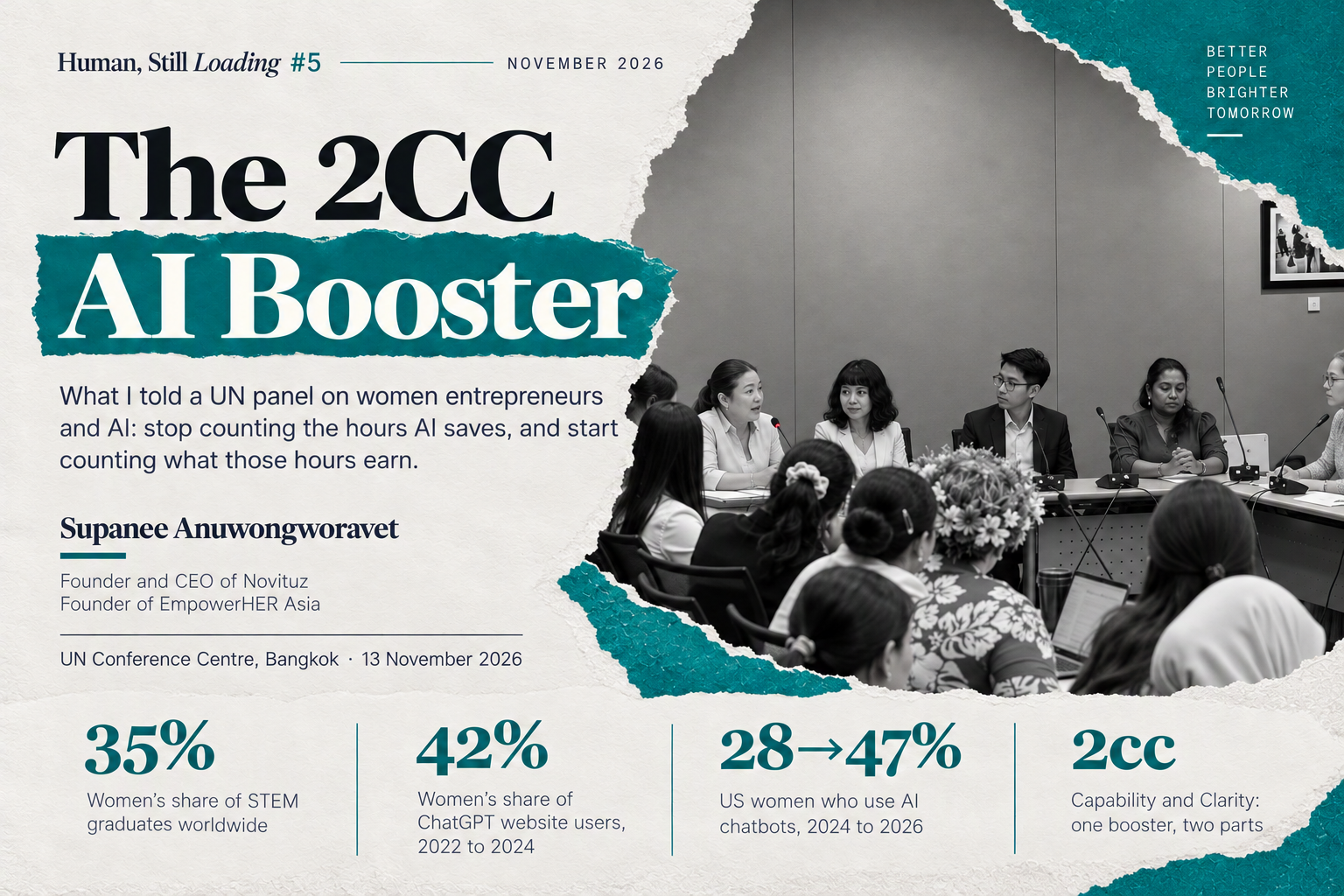
On 13 November I joined a panel at the UN Conference Centre in Bangkok, at a side event titled Women Entrepreneurs in the AI Economy: Skills, Tools and the Road to 2040. The question in the room was simple and hard: how do we make sure AI creates real, inclusive economic opportunity for women entrepreneurs?
I spent nearly 14 years at Microsoft, including as CFO and COO for Thailand and Viet Nam, and I now help businesses, government agencies and schools put AI to work. My answer to the room was a framework I use every day, the 2CC AI Booster. Like a booster dose, it is small, and it has two parts: Capability and Clarity.
And it comes with one rule and one warning. The rule: start with the use case, not the tool, as we did in the Tech for Gov programme for the DGA. The warning: the most common way to measure AI, hours saved, is a trap. The real result is not what AI saves. It is what the business earns.
Section 1
The room and the question
The panel brought the conversation about women’s work in 2040 back to the present: what women running businesses can do with AI now, and what still stands in the way.
The session followed a discussion on the future of care and women’s economic opportunity towards 2040. Our panel moved in two rounds. First, AI in practice: where it is already changing how small, women-led businesses operate and grow. Second, what it would take for many more women entrepreneurs to benefit: skills, resources, policy and partnerships.
Two messages ran through the hour. First, AI is already lowering the cost of running and growing a small business. Second, those gains will not spread on their own. Without deliberate effort, the people who can already use AI will move faster, and those who cannot will fall further behind.
Section 2
The gap is no longer about ability
AI has changed the ticket into technology. The old ticket was a STEM degree and the ability to code. The new ticket is the language we speak every day, and the most valuable skill is judgment.
To begin with, look at the numbers side by side. Women are only about 35% of STEM graduates worldwide, a share that has barely moved in a decade (UNESCO, 2024). Yet women already made up 42% of ChatGPT’s website users between late 2022 and mid-2024 (Otis et al., 2024). In the United States, the share of women who say they use AI chatbots rose from 28% in 2024 to 47% in 2026, almost level with men (Pew Research Center, 2026).
Where the gap remains
However, the gap has not closed everywhere. A Harvard Business School study that brought together 18 studies covering more than 140,000 people found that women adopt generative AI at about a 25% lower rate than men, even when they have the same access. This is partly because women worry more about whether using AI is ethical, and about being seen as less capable if they rely on it (Otis et al., 2024).
I don’t see that as a weakness. I see it as judgment. In fact, concern for ethics, privacy and responsibility is exactly the foundation good AI use needs today. Therefore, the task is to turn that concern into confidence, not to argue women out of it.
Belief and a real business case
So if the door is open, what still stands in the way? In my experience, two things: belief, the quiet voice that says “this is not for me”, and the lack of a real business case. Yet most AI training still teaches people how to use tools. In contrast, very little shows a business owner how a tool turns into money.
Case in point: Tech for Gov. When Novituz delivered the Tech for Gov programme for Thailand’s Digital Government Development Agency (DGA), we made one design choice from the start: begin with the use case, not the tool. Government officers came in with a real problem from their own agency, a queue that was too long, a document check that took days, a question citizens kept asking. They left not with a list of features, but with a working answer to that problem. Meanwhile, the tool was learned on the way. The same rule applies to a woman running a business: start from the job that needs doing, and the AI skill follows.
Section 3
The 2CC AI Booster
A booster does not replace the body’s immune system. It strengthens what is already there. AI works the same way.
2ccThe 2CC AI Booster
C1 · Capability
Multiplier
AI multiplies what the business already does well.
Measure: productivity gainExpander
AI lets the business do what it could not do before.
Measure: new revenue from new products and servicesC2 · Clarity
For decisions the leader owns
AI brings clarity to decisions that a human must make and own.
Kept with people by: governance and new skillsThen where do we measure the gain first? Not in hours saved, but in what those hours earn.
C1 · Capability: Multiplier
AI is a multiplier, but a multiplier needs something to multiply. That something is the expertise a woman has built over a lifetime: her craft, her customers, her taste, her network. AI lets that expertise reach further than one person’s hours allow. In short, this is productivity gain.
C1 · Capability: Expander
So many women tell themselves, “I’m not a tech person” or “I’m not a numbers person.” For the first time, there is a place to try, fail and learn, where no one is watching and no one is judging. As a result, a business can offer products and services it could not offer before. This is new revenue.
C2 · Clarity
As a former CFO, I know that analysing cash flow, testing different prices or planning several scenarios ahead used to be something only large companies could afford. Today, however, a small business owner can do it herself. For a business without a big financial cushion, the clearer you see before you decide, the lower the cost of getting it wrong.
But clarity is not the same as handing over the decision. AI can show the options; the leader still owns the choice. Governance and new skills are what keep those decisions with people.
Section 4
Where do we measure the gain first?
The most common measure of AI success is time saved. It is also the most common trap.
In the AI for Teachers programme, which has reached more than 160,000 teachers in Thailand, teachers got back roughly four hours a week. Of course, that is a real gain. But the important question is: where did those four hours go?
However, time saved is not yet a result. It becomes a result only when it is invested in something that matters: a better lesson, a new customer, a decision made with more care. This is a question I study closely in my doctoral research, and the pattern is clear. Organisations measure what is easy to count, and hours are easy to count.
Stop atHow many hours did AI save us?
Go on toWhat did those hours earn? Which decision did they improve?
The real result is not how much you can save. It is how much you can earn. For women entrepreneurs, the most valuable AI applications are the ones that lower the cost of turning expertise, relationships and ideas into revenue.
Section 5
Bring people to the power
In many places there is internet, but the signal is weak and keeps dropping. Handing out AI tools there is like giving microwaves to homes with constant power cuts.
If we do not fix this, AI will concentrate income even further. But we do not have to wait for every home to have a strong signal. After all, every community already has a centre: a school, a district office, a community hall. Therefore, these can become places where women come together to learn how AI turns what they already know into revenue.
What would make AI work for women entrepreneurs
- Teach the business case, not just the tool. Start from a woman’s own business and show where AI adds money, not only minutes.
- Build belief through safe practice. Give women a place to try, fail and learn without judgment, with responsibility and human-centred use built in from day one.
- Use the places people already gather. Schools, district offices and community halls can be AI learning centres where connections at home are weak.
Closing
Small dose, real strength
A booster works because it builds on what is already inside. So does AI.
In other words, women entrepreneurs do not need to become someone else to benefit from AI. They need Capability, so their expertise reaches further and opens new markets, and Clarity, so they decide with more confidence and keep the decisions that matter in their own hands. Two parts, one booster.
The question I left with the room is the one I leave with you: when AI gives you back your hours, what will you build with them?
For the bigger picture of why AI reaches women’s jobs first, read the previous issue, The Door That Could Close.
References
Sources
- Otis, N. G., Cranney, K., Delecourt, S. and Koning, R. (2024). Global evidence on gender gaps and generative AI. Harvard Business School Working Paper. Summarised in HBS Working Knowledge, 20 February 2025.
- Pew Research Center (2026). Men and women are now equally likely to say they use chatbots. 17 June 2026. Note: the 2024 question was asked only of adults who had heard of chatbots.
- UNESCO (2024). Global Education Monitoring Report gender report: Technology on her terms. Paris: UNESCO. Reported in Careers360.
Human Still Loading #5 · © 2026 Supanee Anuwongworavet, Founder of EmpowerHER Asia