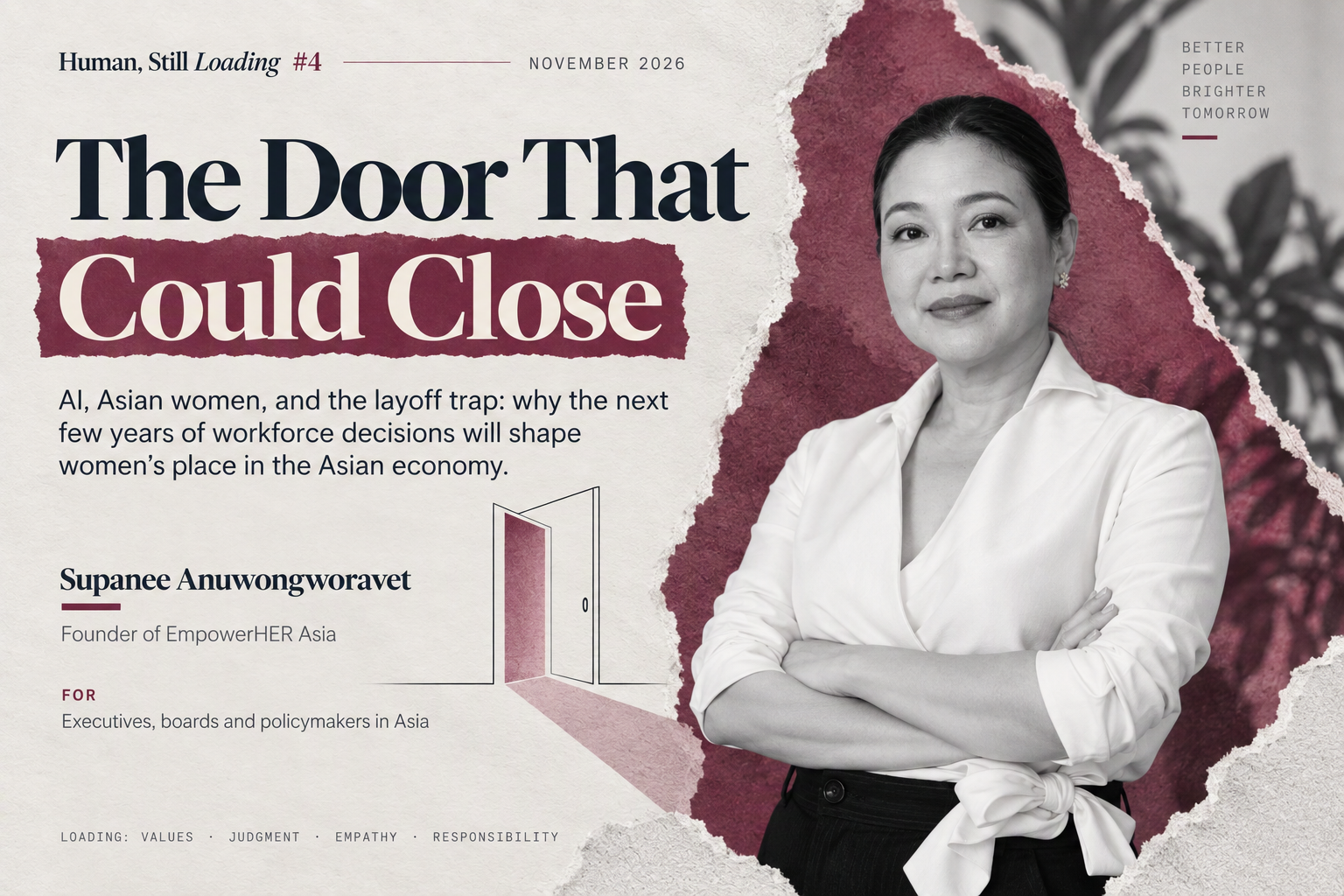

Workforce decision that may shape women’s place in the Asiane economy in AI Era.
80M
ASEAN workers in jobs exposed to generative AI (22.9%)
2×
Women’s likelihood vs men of holding highly exposed jobs in ASEAN
2.2M
Thai workers at risk of task replacement; 55.8% hold a degree
~2×
Over-automation in competitive markets, in the Layoff Trap model
Contents
Executive summary
One technology opened the door. Another could close it.
As a researcher who studies how senior executives in ASEAN make workforce decisions about AI, and as the founder of a network of professional women, I hear the same question from two sides of the table. Leaders ask how far they should automate. Women ask whether their jobs will still exist.
Picture the Thai worker most exposed to AI today. She holds a university degree. She is in her mid-thirties and works in an office in Bangkok, as an accounts clerk, an HR officer or a contact centre agent. For a generation of Asian women, a job like hers was the door into stable, white-collar work. This paper asks whether that door is about to close.
The numbers say the risk is real. In July 2026 the ILO estimated (ILO, 2026b) that nearly 80 million workers in ASEAN, or 22.9% of employment, are in jobs exposed to generative AI, and that women are more than twice as likely as men to hold highly exposed jobs. In Thailand, the NESDC (2026) counts 2.2 million workers at risk of task replacement; 55.8% hold a bachelor’s degree, their average age is 36.5 and 53% work in the Bangkok area.
History shows what is at stake. In the United States, access to the birth control pill in the late 1960s helped young women stay in school, enter law and medicine, and remain in paid work (Goldin and Katz, 2002; Bailey, 2006). One technology opened the door. Generative AI now reaches the very jobs that women walked through.
The danger is in how firms respond. A 2026 economic model (Hemenway Falk and Tsoukalas, 2026) shows that competing firms can be pulled into an automation race that cuts more jobs than is good for anyone, owners included, and that seeing the problem coming does not stop it.
Large-scale cuts have not yet arrived in ASEAN. That is the window. This paper asks three groups to use it:
- Executives: treat an AI-driven job cut as an irreversible capital decision and count what leaves with the people.
- Policymakers: the trap is a collective problem, so the rules must change for every firm at once.
- Women professionals and their networks: build AI skills early, make hidden value visible, and claim a seat where these decisions are made.
Section 1
A door that opened
When women gained control over the timing of their own lives, they invested in careers. The clearest evidence comes from the United States.
The Pill was approved in 1960, but young unmarried women could not legally obtain it in most states until the late 1960s and early 1970s, when states lowered the age of majority. Because these laws changed at different times in different states, economists could measure what the Pill actually did.
- Goldin and Katz (2002) found that the Pill lowered the cost for women of long professional training. The share of women among new students in law, medicine, dentistry and business rose sharply from around 1970. Claudia Goldin received the 2023 Nobel Prize in Economics for her work on women’s labour market outcomes.
- Bailey (2006) found that legal access before age 21 reduced first births before age 22 by 14 to 18 percent and raised women’s labour force participation at ages 26 to 30. Women with early access worked at least 68 more hours a year in their late twenties.
The steepest part of the climb began around 1970, the same years young women gained legal access to the Pill. The rise then levelled off near 60% after 2000. A long climb like this is built over decades, and it can stall or reverse when the jobs that carried it change.
The break came around 1970, as the first cohorts with legal access to the Pill graduated from college. In medicine, where the authors could check, the rise came almost entirely from more women applying, not from schools admitting a larger share of the women who applied.
The Pill was not the only force. New laws, household technology and changing norms also mattered, and the US is not Asia. The authors themselves stress that no great social change has a single cause. But the lesson holds: when a barrier to women’s working lives falls, women walk through, and the whole economy gains their skills.
Section 2
A door that could close
In Asia, the jobs most exposed to generative AI are the jobs that first brought women into stable, white-collar work.
Clerical and secretarial roles, HR administration, accounting support, legal support, customer service and contact centres all rest on repetitive, rule-based, accuracy-driven tasks. These are the tasks AI does best.
Across ASEAN. The ILO’s July 2026 report on ASEAN (ILO, 2026b) estimates that 22.9% of employment, nearly 80 million workers, is in jobs with more than minimal exposure to generative AI. Exposure is highest in Singapore (42.2%) and stands at 20.6% in Thailand. Women are more than twice as likely as men to work in highly exposed jobs, because they hold a large share of clerical and administrative roles. Globally, an ILO brief from March 2026 (ILO, 2026a) finds that female-dominated occupations are almost twice as exposed as male-dominated ones (29% against 16%), while women remain under-represented in AI-related jobs.
In Thailand. The NESDC (2026) estimates that 8.7 million of 40.1 million workers are affected by generative AI and 2.2 million face task replacement risk. Of the most exposed group, 55.8% hold a bachelor’s degree or higher, the average age is 36.5 and 53% work in the Bangkok area. This is not a low-skill story.
| Thai occupation group at task replacement risk | Estimated workers |
|---|---|
| Clerks, secretaries and office support | about 1,000,000 |
| Customer service, reception and PR (incl. about 310,000 contact centre agents) | about 540,000 |
| Accounting, finance and statistics staff | about 260,000 |
Source: NESDC, Thailand Social Situation Report Q1 2026, via Bangkok Post (25 May 2026).
The first rung of the ladder. The Pill widened the path into work by giving women more control. AI may narrow it from the other side, by removing the jobs women use to enter. The ILO has warned that some clerical jobs that drew women into work as economies developed may never emerge at all in lower-income countries (Gmyrek, Berg and Bescond, 2023).
Thailand starts from a stronger position than the world average, but women’s participation has slipped from 67.7% in 1997 to 59.0% in 2025 (World Bank, 2026). This decline began long before generative AI, and its causes are outside the scope of this paper. The point is the direction of risk: if AI removes the clerical and service jobs that hold many Thai women in work, it would add pressure to a line that is already falling. Data after 2022 is too recent to show any AI effect, so this is the line to watch.
Exposure is not job loss, and the ILO finds no evidence yet of large-scale cuts in ASEAN. Adoption in office and administrative roles is still limited. Whether these jobs become better jobs or disappear will depend on choices leaders make in the next few years.
Section 3
Why firms may cut too far: the AI Layoff Trap
Well-informed firms can still cut too many jobs, because the market rewards each of them for doing so.
This is the core finding of The AI Layoff Trap, a 2026 working paper by Brett Hemenway Falk (University of Pennsylvania) and Gerry Tsoukalas (Boston University) (Hemenway Falk and Tsoukalas, 2026).
The basic math. When a firm replaces a worker with AI, it keeps the whole cost saving. But that worker is also a customer. Her lost income reduces spending across the whole market, so each firm feels only a small share of the demand it destroys.
Why it is a trap. In a market with many competitors, automating more becomes each firm’s best move no matter what rivals do, even when every firm can see the demand loss coming. In the authors’ illustration, a competitive market automates about twice as much as would be best for all firms together. Promises to hold back do not last, because breaking them always pays. More competition and better AI make the gap wider, not smaller.
Everyone loses. The result is not just a transfer from workers to shareholders. Both lose: workers lose income and owners lose profit. Even a planner who cared only about profits would choose less automation. The case for restraint rests on arithmetic, not only on ethics.
What fixes it, according to the model.
Does not fixUniversal basic income, a general tax on capital, voluntary agreements between firms
Narrows the gapUpskilling and worker ownership stakes
Closes the gapA tax on automation set to the demand loss it causes, with revenue used to fund retraining
Limits. The paper is not yet peer reviewed (version 3, June 2026). It models identical firms in one sector, and the authors note that displacement has not yet reached the scale the model needs. It does not study gender. The link to women is ours: if the trap operates, it will operate first in the jobs described in Section 2.
Section 4
A strategic error, not only an ethical one
Inside each firm there is a second cost: when people leave, knowledge that was never written down leaves with them.
A long-serving HR officer knows which policy exceptions keep a key team from quitting. A contact centre agent knows how to calm a loyal client before a complaint becomes a cancellation. None of this appears in an AI business case. Research on downsizing has long shown that such knowledge is hard to measure and easy to lose (Massingham, 2008; Schmitt, Borzillo and Probst, 2012).
“A tremendous trap, a terrible trap.”Raffaella Sadun, Harvard Business School, on the hope that AI can replace investment in people (Boles, 2026)
Sadun argues that cutting people trades short-term savings for long-term problems, and treats training as strategy rather than corporate social responsibility.
AI also depends on the people it replaces. In a study of 5,172 customer support agents, an AI assistant raised productivity by about 15%, with the largest gains for less experienced staff, by spreading the know-how of the best agents (Brynjolfsson, Li and Raymond, 2025). Remove the experienced people and the source of that know-how goes too. Klarna learned a version of this: after saying in 2024 that AI was doing the work of about 700 agents, it began hiring human agents again in 2025 when service quality fell (Bloomberg, 2025).
A job cut in the AI era is closer to selling an asset than to trimming a cost. It deserves the same discipline.
Section 5
What to do
Firms face the trap, governments set the rules, and workers need the means to move. Each has a part to play.
For executives and boards
- Run a reversibility check. If this cut proves wrong, can we undo it within 6 to 12 months? If not, slow down and treat it as an irreversible decision.
- Count what leaves, and who. Put the knowledge and client relationships each role carries next to the cost saving, and review every AI workforce plan by gender and age. If cuts fall mainly on women, ask whether that is a choice or an accident.
- Redeploy before you remove. Move people into roles that supervise and improve AI output, as the NESDC recommends (NESDC, 2026). Create safe channels for staff input, since silence in a hierarchy is not agreement.
For policymakers
- Treat the trap as a collective problem. Individual firms will keep chasing the lowest cost. As Harvard economist Doug Elmendorf notes, collective-action problems are the job of government (Boles, 2026).
- Fund transitions and test new tools. Wage insurance, retraining tied to real jobs and support for workers over 45 keep skills in the economy. An automation levy that funds retraining deserves serious study, though it needs local testing and regional coordination.
- Close the rule gap and measure by gender. AI governance in ASEAN is still largely voluntary (Fong, 2026). Clear rules on notice and consultation in AI-related dismissals, plus data split by sex and age, would let problems be seen early.
For women professionals and their networks
- Build AI fluency now. The safest roles manage AI rather than compete with it.
- Make hidden value visible. Write down the judgement and relationships your role carries. What is not seen is easy to cut.
- Move together and claim a seat. Use networks for peer learning and mentoring into AI roles, and push for women on AI and workforce committees.
Section 6
Conclusion: use the window
Half a century ago, a technology helped open a door, and women walked through it into law, medicine, business and paid work. Today another technology is arriving at the jobs that let millions of Asian women through that door.
The Layoff Trap shows that good intentions inside one company are not enough. Harvard’s research shows that cutting people can destroy the knowledge that makes AI useful. The ILO’s data shows that women stand first in line.
The message is not that AI must be stopped. It is that the way leaders decide now will shape whether AI widens women’s paths into work or narrows them. ASEAN has not yet seen large-scale cuts. That window is still open, but it will not stay open by itself.
References
Sources
- Bailey, M. J. (2006). More power to the pill: The impact of contraceptive freedom on women’s life cycle labor supply. The Quarterly Journal of Economics, 121(1), 289-320.
- Bangkok Post (2026). AI growth puts 8.7m Thai jobs at risk. 25 May 2026.
- BLS (2025). Labor force participation rate, women (LNU01300002). US Bureau of Labor Statistics, via FRED, Federal Reserve Bank of St. Louis.
- Bloomberg (2025). Reporting on Klarna rehiring human customer service agents, May 2025.
- Boles, S. (2026). Why AI hasn’t triggered mass layoffs, yet. Harvard Gazette, 29 September 2026.
- Brynjolfsson, E., Li, D. and Raymond, L. (2025). Generative AI at work. The Quarterly Journal of Economics, 140(2), 889-942. doi:10.1093/qje/qjae044
- Fong, K. (2026). What is shaping artificial intelligence (AI) governance policies in Southeast Asia? ISEAS Perspective, 2026(13). ISEAS Yusof Ishak Institute.
- Gmyrek, P., Berg, J. and Bescond, D. (2023). Generative AI and jobs: A global analysis of potential effects on job quantity and quality. ILO Working Paper 96. International Labour Organization, Geneva.
- Goldin, C. and Katz, L. F. (2002). The power of the pill: Oral contraceptives and women’s career and marriage decisions. Journal of Political Economy, 110(4), 730-770.
- Hemenway Falk, B. and Tsoukalas, G. (2026). The AI layoff trap. arXiv:2603.20617, version 3, 3 June 2026. Working paper, not peer reviewed.
- ILO (2026a). Gen AI, occupational segregation and gender equality in the world of work. Research brief, 5 March 2026.
- ILO (2026b). Generative AI and labour markets in ASEAN: Significant exposure, limited disruption, uneven preparedness. July 2026. Reported by WAM, 8 July 2026.
- Massingham, P. (2008). Measuring the impact of knowledge loss: More than ripples on a pond? Management Learning, 39(5), 541-560. doi:10.1177/1350507608096040
- NESDC (2026). Thailand Social Situation Report, Q1 2026. Office of the National Economic and Social Development Council, Bangkok, 25 May 2026.
- Schmitt, A., Borzillo, S. and Probst, G. (2012). Don’t let knowledge walk away: Knowledge retention during employee downsizing. Management Learning, 43(1), 53-74. doi:10.1177/1350507611411630
- World Bank (2026). Labor force participation rate, female (% of female population ages 15+), modelled ILO estimate. World Development Indicators, updated 13 July 2026.
Human Still Loading #4 · © 2026 Supanee Anuwongworavet, Founder of EmpowerHER Asia